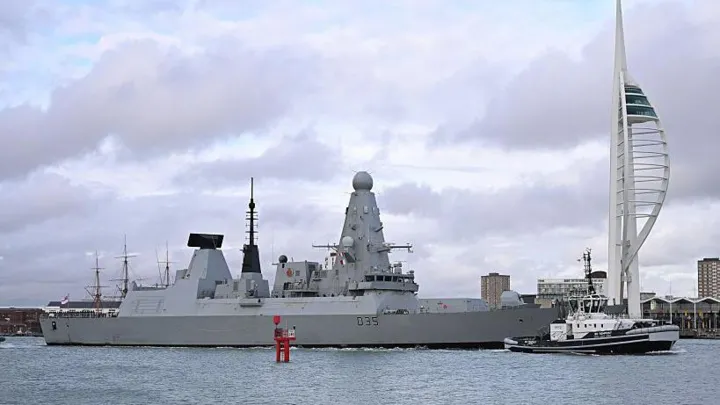
HMS Dragon docks after minor technical issue
The Type 45 destroyer HMS Dragon pauses operations in the eastern Mediterranean to resolve a minor water‑system fault while maintaining a high state of readiness.
Operational background and recent deployment
HMS Dragon, one of the Royal Navy’s six Type 45 air‑defence destroyers, was dispatched to the eastern Mediterranean with the explicit purpose of safeguarding British air installations on the island of Cyprus. The decision to send HMS Dragon followed a missile‑type attack on the British‑controlled airfield RAF Akrotiri, an event that prompted senior officials to reinforce the defensive posture of United Kingdom forces in the region.
The deployment of HMS Dragon was announced publicly by Sir Keir Starmer, who confirmed that the warship would join existing British assets to protect RAF Akrotiri and other strategic locations. After leaving the naval base at Portsmouth, HMS Dragon entered the eastern Mediterranean theatre, where it integrated with a broader multinational framework that includes United Kingdom air, land and naval units operating in a high‑threat environment.
Since arriving in the area, HMS Dragon has been operating alongside RAF Typhoon fighters, F‑35 Lightning aircraft, Voyager aerial refuelling platforms, and a variety of Royal Navy helicopters, including Merlin and Wildcat models. These forces collectively provide a layered defence capable of responding to a range of aerial and missile threats.
Nature of the technical issue
During its recent operational patrol, HMS Dragon encountered a malfunction in its onboard water‑distribution system. Ministry of Defence officials described the problem as “minor” and noted that the issue pertains specifically to the ship’s ability to circulate fresh water for certain onboard functions.
Despite the technical difficulty, Ministry of Defence sources emphasized that the problem does not compromise the vessel’s core combat capabilities. The water‑system fault is classified as a logistical concern rather than a combat‑system failure, allowing HMS Dragon to continue fulfilling its primary mission while the necessary repairs are carried out.
All personnel aboard HMS Dragon, estimated to be around two hundred crew members, have retained access to drinking water, food services and shower facilities. The ship’s catering and sanitation provisions remain fully operational, ensuring that crew welfare is not adversely affected while the repair work proceeds.
Planned maintenance and logistical stop
In response to the water‑system malfunction, HMS Dragon will dock for a short maintenance period that Ministry of Defence officials have termed a “routine logistics stop.” During this interval, the vessel will take on additional provisions, optimise a range of onboard systems and carry out the necessary technical repairs to restore full functionality to the water‑distribution network.
The logistical stop is designed to be brief, enabling HMS Dragon to resume its operational duties without an extended interruption. Ministry of Defence representatives stressed that the ship will retain “a very high level of readiness” throughout the maintenance window, meaning that HMS Dragon will be capable of sailing at short notice should the operational situation demand an immediate redeployment.
Ministry of Defence officials also highlighted that the maintenance period provides an opportunity to conduct routine checks on other critical systems, ensuring that HMS Dragon remains in optimal condition for the demanding tasks it is expected to perform in the eastern Mediterranean theatre.
Readiness and combat capability
Even while docked for the short maintenance interval, HMS Dragon will continue to be listed as a high‑readiness asset. The ship’s combat systems, including its advanced radar and missile‑launch capabilities, remain fully functional. This status guarantees that HMS Dragon can be re‑manned and dispatched on very short notice to respond to any emerging threats against United Kingdom assets or allied interests in the region.
The ability to maintain such a high state of readiness while addressing a minor technical issue reflects the robust logistical support framework that underpins Royal Navy operations. The support infrastructure ensures that even when a vessel is undergoing minor repairs, it does not lose the capacity to re‑engage in combat operations promptly.
Both Ministry of Defence officials and senior naval officers have reiterated that the temporary dockside period will not diminish the strategic deterrent value that HMS Dragon provides to regional partners and allies.
Capabilities of HMS Dragon and the Type 45 class
HMS Dragon belongs to the Type 45 class of air‑defence destroyers, which represent the most technologically advanced surface combatants in the United Kingdom’s naval fleet. The Type 45 design centres on anti‑aircraft and anti‑missile warfare, featuring a sophisticated suite of sensors, weapons and command‑and‑control systems.
The ship is equipped with the Sea Viper air‑defence missile system, a highly automated platform capable of launching eight missiles within a ten‑second window. This rapid‑launch capability, combined with the ship’s ability to track hundreds of aerial targets simultaneously, provides a formidable shield against incoming aircraft, cruise missiles and other aerial threats.
In addition to Sea Viper, HMS Dragon carries an array of close‑in weapons, electronic‑warfare systems and advanced communications equipment that enable seamless integration with allied naval and aerial forces. These capabilities allow HMS Dragon to operate both independently and as part of a coordinated multinational task force.
Regional air operations and allied contributions
Across the eastern Mediterranean, United Kingdom air forces continue to conduct defensive patrols and air‑defence missions. RAF Typhoon jets and F‑35 Lightning aircraft maintain a persistent presence over critical airspace, ready to intercept any hostile incursions.
Supporting these combat aircraft are Voyager aerial refuelling platforms, which extend the operational range of fighter sorties and enable sustained air‑cover operations. Royal Navy helicopters, including Merlin models equipped with Crowsnest airborne surveillance systems, provide persistent radar coverage, early warning and target tracking capabilities across the maritime domain.
In a recent operational update, Ministry of Defence officials confirmed that ground‑based RAF Regiment gunners, operating in a “high‑threat area,” successfully engaged and destroyed an Iranian‑origin drone that posed a threat to the region. This action underscores the integrated nature of United Kingdom forces, where land‑based air‑defence assets complement naval and aerial platforms.
Maritime security concerns and the Strait of Hormuz
The strategic maritime corridor known as the Strait of Hormuz remains a focal point for international security discussions. This narrow waterway, which connects the Persian Gulf with the Arabian Sea, is a vital conduit for global oil shipments and is situated near the coastlines of Iran, the United Arab Emirates and Oman.
Recent tensions have raised concerns about potential disruptions to shipping traffic in the Strait of Hormuz, especially in light of threats from Iranian forces targeting commercial vessels. The possibility of attacks on merchant ships has contributed to volatility in global oil prices, prompting a need for coordinated international monitoring and response mechanisms.
In response to these maritime security challenges, the United Kingdom will host a multinational military planning conference focused on the Strait of Hormuz. The conference aims to explore “appropriate measures for an international coalition when hostilities have ceased,” according to officials, and will examine collaborative strategies for safeguarding global shipping routes.
Conclusion
The temporary docking of HMS Dragon to address a minor water‑system fault does not diminish the ship’s pivotal role in maintaining United Kingdom security interests in the eastern Mediterranean. By conducting a short maintenance stop, HMS Dragon ensures that all of its systems are fully operational while remaining prepared to sail on short notice.
Combined with the broader array of United Kingdom air, land and maritime assets operating in the region, HMS Dragon continues to provide a critical layer of defence for RAF Akrotiri and allied interests. The ongoing multinational efforts to secure the Strait of Hormuz further illustrate the United Kingdom’s commitment to upholding global maritime stability.
Through diligent maintenance, high readiness and seamless integration with partner forces, HMS Dragon exemplifies the resilience and flexibility of modern naval power in the face of evolving regional challenges.