Hundreds Assemble for Dissident Republican Easter Parade in Londonderry
Young demonstrators brandished petrol bombs as the march reached the City Cemetery, raising security concerns.
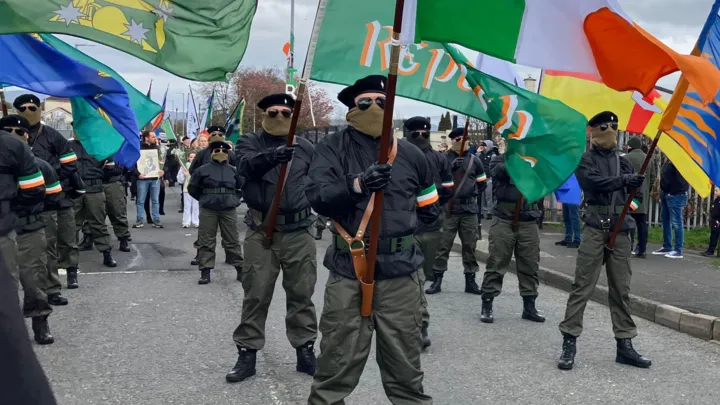
Background to the Commemoration
Each year, various groups stage marches to mark the anniversary of the 1916 Easter Rising, an event that remains a potent symbol in Irish republican history. In the most recent iteration, a dissident republican faction organised a sizeable march that began in the suburb of Creggan and proceeded toward the historic City Cemetery in the centre of Londonderry. The organising body, identified as Saoradh, has previously been linked by the Police Service of Northern Ireland to the New IRA, a designation that underscores the heightened scrutiny surrounding the event.
The Parades Commission, the statutory authority responsible for regulating public processions in Northern Ireland, issued a determination ahead of the march. The determination explicitly warned that participants must refrain from wearing paramilitary‑style clothing and from displaying any illegal flags. Despite this clear guidance, the march proceeded in a manner that directly contravened the stipulated rules.
Details of the March Route and Participants
On Monday, several hundred individuals gathered at the starting point in Creggan. Among the crowd were participants dressed in combat‑style uniforms and a number of persons whose faces were concealed by masks or other coverings. The procession was led by a contingent of eighteen marchers clad in paramilitary‑style attire, a visual element that directly breached the Parades Commission’s prohibition on such dress.
The march proceeded along a designated route that took the participants from Creggan to the City Cemetery. At the outset, the procession paused briefly at the republican monument situated within Creggan, where a man clad in paramilitary‑style clothing placed a wreath as a symbolic act of remembrance. This brief interlude highlighted the overt political messaging embedded within the march.
According to the Saoradh national committee, the event was planned to feature one flute band and to involve approximately five hundred participants and supporters. The organisational statement also emphasized a desire to demonstrate continuity with the historic Easter Rising, albeit through a modern lens that resonates with dissident republican sentiment.
Security Concerns and Police Response
The Police Service of Northern Ireland reported a series of incidents that unfolded concurrently with the march. Chief Superintendent Gillian Kearney of the Police Service of Northern Ireland disclosed that a live investigation remains underway, focusing on potential breaches of both the Terrorism Act 2000 and the Parades Commission determination.
During the progression of the march, the Police Service of Northern Ireland confirmed that a vehicle had been set alight on Central Drive in Creggan. In response to the fire, the Police Service of Northern Ireland issued an advisory to the public, urging residents to avoid the immediate vicinity of Central Drive and to seek alternative routes when traveling through the area.
When the procession reached the City Cemetery, onlookers observed roughly twelve young individuals wearing masks and displaying petrol bombs. The presence of these incendiary devices heightened tension and prompted a rapid escalation of police activity surrounding the cemetery grounds.
Chief Superintendent Gillian Kearney reiterated the Police Service of Northern Ireland’s commitment to investigating any offences that arise from the march, stating: “The outcomes of our investigations from previous years illustrate that where offences occur, the Police Service of Northern Ireland will investigate fully.” This statement underscores the ongoing dedication of the Police Service of Northern Ireland to enforce the law, even in the context of politically charged public demonstrations.
Historical Context of Related Violence
The current march bears a stark resemblance to an incident that occurred in the previous year. At that time, similar dissident republican celebrations escalated into violence, with rioters hurling approximately fifty petrol bombs at police officers positioned near the historic city walls. The recurrence of such tactics, including the use of petrol bombs, signals a persistent pattern of confrontation associated with these types of commemorative processions.
Both the present and past incidents have drawn criticism from community leaders, security analysts, and political figures who argue that the deployment of paramilitary symbolism and the active use of incendiary devices serve only to inflame sectarian divisions. The Parades Commission’s explicit warning against paramilitary‑style clothing and illegal flags reflects an institutional effort to mitigate such tensions, an effort that appears to have been disregarded in the present march.
Official Statements and Community Reaction
In a formal press brief, Chief Superintendent Gillian Kearney of the Police Service of Northern Ireland outlined the investigative steps being taken. The statement emphasized that any individuals observed wearing paramilitary‑style uniforms could be committing an offence under the Terrorism Act 2000, in addition to breaching the Parades Commission determination. The Police Service of Northern Ireland therefore positioned itself to pursue legal action against any identified offenders.
Community members in Creggan expressed a mixture of concern and frustration. While some participants claimed that the march represented a legitimate form of cultural expression, others voiced unease about the overt display of militarised attire and the potential for violence that accompanied the presence of petrol bombs. Local residents were urged by the Police Service of Northern Ireland to remain vigilant and to report any suspicious activity to the nearest police station.
Saoradh, the organising political party, defended the march as a peaceful tribute to the 1916 Easter Rising. In statements released to the media, Saoradh reiterated its commitment to honouring the historic event without resorting to violence, despite the observable presence of petrol bombs among a small subset of participants. Saoradh also highlighted the inclusion of a single flute band as a nod to traditional Irish musical heritage.


