Eden Gardens Drainage System in Kolkata: Timeline for Resuming KKR Vs PBKS After Rain
Heavy rain halted the KKR Vs PBKS IPL 2026 clash at Eden Gardens, Kolkata. This article explains the advanced drainage infrastructure of Eden Gardens and details exactly how long ground staff will need to ready the pitch once rain ceases.
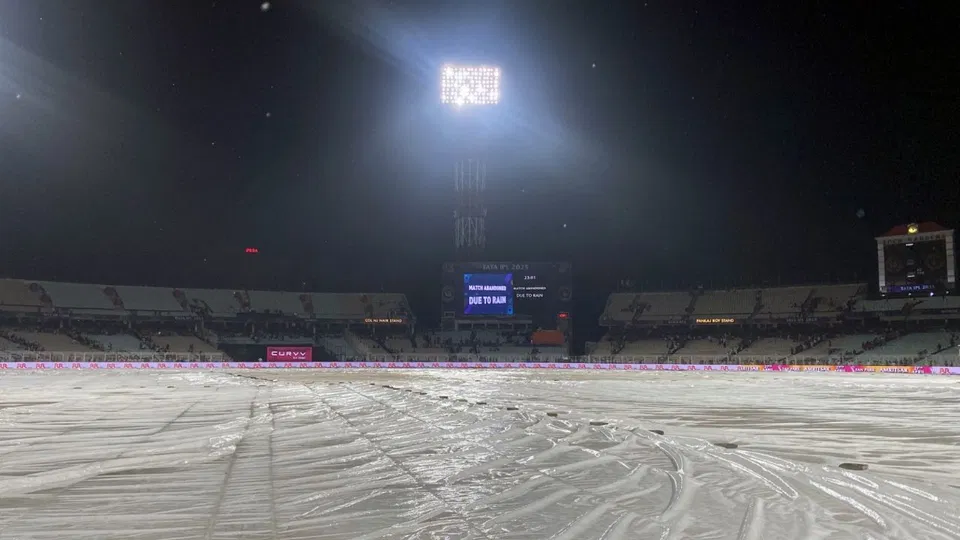
The inevitable happened, and the KKR Vs PBKS IPL 2026 match was stopped due to heavy rain at Eden Gardens, Kolkata. Accuweather predicted that the crucial IPL match would be hampered because of rain, and the predictions came true as both sets of players had to walk off the field after 3.4 overs.
Eden Gardens squares were immediately covered as the rain intensified and the development left fans in disarray, because the KKR Vs PBKS IPL match was poised to be a thriller.
KKR was pushed on the back foot by Punjab Kings bowlers, and the rain break will surely be frustrating for the visiting side. Eden Gardens boasts one of the best drainage systems in India, and if the rain stops, how long does it take for the game to resume? The following sections provide a complete detail.
Eden Gardens Drainage System: Will KKR Vs PBKS Resume?
Eden Gardens in Kolkata features a high‑performance subsurface drainage system, and the design is often regarded as one of the best in India alongside Chinnaswamy Stadium. The engineering of Eden Gardens drainage system incorporates deep coring, multiple super soppers, full‑ground covers, and modern, efficient water‑removal machinery.
When rain ceases, Eden Gardens drainage system allows ground staff to ready the playing surface for KKR Vs PBKS IPL 2026 match within a short window. According to the specifications of Eden Gardens drainage system, the turnaround time is estimated at 20‑30 minutes for ground staff to make the pitch playable again.
Eden Gardens drainage system uses a network of underground pipes that channel water away from the surface rapidly, ensuring that standing water does not linger on the outfield. The pipe network is laid at strategic intervals beneath the playing area, and the gradient of each pipe is calibrated to accelerate water flow toward collection points.
In addition to the pipe network, ground staff employ four super soppers to extract water that accumulates on the surface. The four super soppers operate simultaneously, each drawing water into high‑capacity holding tanks that are subsequently emptied through the underground pipe network.
The combined effect of the underground pipe network, deep coring, full‑ground covers, and the four super soppers enables Eden Gardens drainage system to achieve the rapid water removal required for IPL‑level matches.
Step‑by‑Step Process Followed by Ground Staff After Rain
Once the rain stops, ground staff at Eden Gardens initiate a sequence of actions that are predefined for IPL matches. The first action is to assess the total volume of water on the playing surface using visual inspection and moisture‑sensor readings. The assessment confirms that the surface water level is within the handling capacity of the four super soppers.
Next, ground staff deploy the four super soppers across the outfield. Each super sopper is positioned at a location that maximises coverage and ensures that no area of the outfield is left untreated. The four super soppers operate for approximately 5‑7 minutes, pulling water into their onboard reservoirs.While the four super soppers are active, the underground pipe network continues to convey water away from the pitch. The pipe network works in parallel with the super soppers, reducing the overall drainage time.
After the four super soppers have completed their run, ground staff use high‑pressure air blowers to dry any remaining damp patches on the pitch. The air blowers target the central strip where batting will occur, as well as the areas around the wickets.
Finally, ground staff perform a safety inspection of the playing surface. The inspection verifies that the grass cover is intact, that the pitch hardness falls within the acceptable range for competitive cricket, and that the outfield is free of pooling water.
When the safety inspection is signed off, the officials are notified that KKR Vs PBKS IPL 2026 match can resume. The entire sequence, from the moment rain stops to the moment of official clearance, typically occupies a 20‑30 minute window when Eden Gardens drainage system functions at full efficiency.
Comparison With Other Indian Stadiums
Eden Gardens drainage system is frequently mentioned alongside the drainage infrastructure at Chinnaswamy Stadium. Both venues employ deep coring, multiple super soppers, and extensive underground pipework. However, Eden Gardens drainage system distinguishes itself by the density of its pipe network and the capacity of its four super soppers, which together enable a turnaround time of 20‑30 minutes under IPL conditions.
Chinnaswamy Stadium also achieves a rapid drainage rate, but the reported turnaround time for a similar rain‑stop scenario typically ranges from 25‑35 minutes. This slight difference is attributable to variations in pipe layout and the number of super soppers deployed at each venue.
The comparison underscores why Eden Gardens drainage system is regarded as one of the premier cricket‑drainage solutions in India, particularly for high‑stakes matches such as KKR Vs PBKS IPL 2026.
Impact on Players, Fans, and Broadcast Schedules
For KKR, the brief interruption caused by rain is a tactical challenge, as momentum built in the early overs must be preserved despite the pause. For Punjab Kings, the rain break offers an opportunity to regroup and adjust bowling strategies before play resumes.
Fans in the stands at Eden Gardens experience a mixture of anticipation and uncertainty during the rain delay. The rapid action of Eden Gardens drainage system, however, reassures spectators that the match will likely continue within a short time frame, reducing the likelihood of a full‑day abandonment.
Broadcasters covering KKR Vs PBKS IPL 2026 also rely on the efficiency of Eden Gardens drainage system to maintain schedule integrity. A 20‑30 minute drainage window aligns with television slot allocations, allowing commentators to fill the brief intermission with analysis while awaiting official clearance.
Future Outlook and Continuous Improvements
Eden Gardens management continues to monitor advances in drainage technology. While Eden Gardens drainage system already meets the rigorous standards required for IPL matches, the venue explores options such as automated moisture sensors and real‑time water‑level monitoring to further shorten the turnaround time after rain.
Ground staff at Eden Gardens undergo regular training on the operation of the four super soppers and the maintenance of the underground pipe network. This ongoing training ensures that the personnel responsible for preparing the pitch are fully equipped to handle any rain‑related interruption during KKR Vs PBKS IPL 2026 or future fixtures.
As climate patterns evolve and the frequency of heavy rain events potentially increases, Eden Gardens remains committed to preserving its reputation as a venue that can swiftly resume world‑class cricket after weather disruptions.


