Children Explore Irish Famine Narrative Deemed More Relevant Than Ever
The tale of Eily, Michael and Peggy surviving the mid‑19th‑century Irish famine comes alive in an interactive showcase at the Ulster American Folk Museum, a display that author Marita Conlon‑McKenna says resonates with today’s global challenges.
A famine that claimed the lives of millions and forced countless others to leave their homes may, at first glance, appear too heavy a subject for a work aimed at young readers.
Nevertheless, Under the Hawthorn Tree has captured the imaginations of several generations and now serves as the centerpiece of a brand‑new, fully interactive exhibition.
The story follows the siblings Eily, Michael and Peggy as they struggle to survive the Irish famine of the mid‑19th century, and that narrative has been transformed into a hands‑on display that invites visitors to step inside the world of the novel.
Marita Conlon‑McKenna, author of Under the Hawthorn Tree, explains that worldwide events make the historical tale feel especially pertinent in the present day.
Marita Conlon‑McKenna said, "It has echoes with famine, displacement, with things that are happening in people's lives," emphasizing the timeless resonance of the narrative.
Marita Conlon‑McKenna added, "I can understand how it just has this appeal and draws people in."
Author’s Reaction to the New Showcase
Marita Conlon‑McKenna expressed that she was "blown away" by the scale and detail of the exhibition hosted at the Ulster American Folk Museum in County Tyrone.
Under the Hawthorn Tree appears on school curricula across the globe, a fact that Marita Conlon‑McKenna highlighted by stating, "It's everywhere."
Marita Conlon‑McKenna noted, "It is in nearly every language in the world and children in schools all over the world and everywhere are reading it on the curriculum in Mexico and parts of America."
Marita Conlon‑McKenna travels extensively, meeting pupils in primary schools, secondary schools, colleges and universities, a journey she describes as "amazing" because a modest tale set in Ireland has attained a truly global reach.
Seeing Under the Hawthorn Tree interpreted through tactile displays and immersive environments proved "so special" for Marita Conlon‑McKenna, a writer originally from Dublin.
Marita Conlon‑McKenna said, "It has far surpassed my expectations – the design and the elements are just everything. The book is here in the exhibition; it's fantastic."
Curatorial Vision and Museum Context
The Ulster American Folk Museum has not unveiled a brand‑new permanent installation in four years, making this exhibition a noteworthy milestone for the institution.
Victoria Miller, senior curator of history at the Ulster American Folk Museum, hopes that the new display will attract both repeat visitors and those encountering the museum for the first time, stating that many people "want to have a different experience when they come here".
Victoria Miller argued, "The past is a really useful marker for us today both in terms of our current lives but also planning for the future," underscoring the relevance of historical storytelling for contemporary audiences.
Victoria Miller continued, "And there's always something to be learnt from the past to help inform how we live our lives today," reinforcing the educational intent behind the exhibition.
Centerpiece Sculpture and Craftsmanship
At the heart of the Ulster American Folk Museum exhibition stands a monumental hawthorn sculpture, an intricate work of art fashioned from flexible willow branches.
Bob Johnston, the museum’s dedicated willow weaver, was commissioned to craft the large‑scale representation of the tree that lends the exhibition its title and visual anchor.
Bob Johnston’s method combines traditional weaving techniques with contemporary design, producing a structure that both respects historical craft and invites modern interaction.
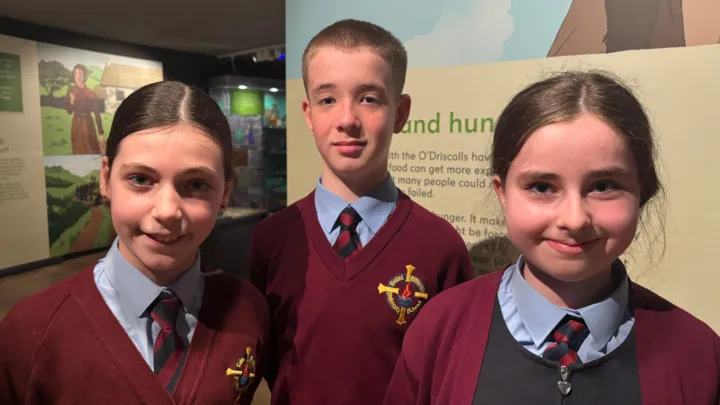
First School Visit: P7 Pupils from St Eithne’s School, Derry
The inaugural school group to explore the new Ulster American Folk Museum exhibit consisted of P7 pupils from St Eithne’s School in Derry, a cohort that had just finished reading Under the Hawthorn Tree before stepping into the exhibition.
Macey, age 11, reflected on the reading experience, saying, "When I read Under the Hawthorn Tree I felt like I was in it," a sentiment echoed by many of the visiting children.
Liam, age 11, expressed enthusiasm for the exhibition, noting that his favourite element was the combination of spoken narratives and evocative scents, which together "brought the story to life".
Abigail, age 11, described Under the Hawthorn Tree as "a real cliff‑hanger" and was thrilled to have the opportunity to converse directly with Marita Conlon‑McKenna during the visit.
Abigail added, "My favourite thing was getting to ask the author questions and really getting to know what she did to make the book," highlighting the educational impact of author‑student interaction.
Marita Conlon‑McKenna observed that watching the children move through the immersive environment was a profound experience, saying, "Watching the children going around has blown me away because the children just love it."
Marita Conlon‑McKenna further explained, "How it's been brought to life makes my characters walk off the page and walk into the exhibition; it's just incredible. How this small, lucky book just changed my life."
Broader Educational Impact
Under the Hawthorn Tree continues to serve as a vehicle for teaching young readers about resilience, community, and the harsh realities of historical famine, while also fostering empathy for contemporary situations involving displacement and scarcity.
The interactive exhibition at the Ulster American Folk Museum adds a sensory dimension to the novel, allowing children to not only read about the hardships faced by Eily, Michael and Peggy but also to experience recreated sounds, aromas, and visual cues that mirror the environment described in the book.
By integrating the literary work with tactile displays, the Ulster American Folk Museum provides educators with a multifaceted teaching tool that reinforces curriculum objectives and deepens students’ connection to historical narratives.
The exhibition also serves as a reminder, as articulated by Victoria Miller, that historical knowledge can inform present‑day decision‑making, suggesting that lessons drawn from the Irish famine may help societies navigate modern challenges such as food insecurity and forced migration.